Technology
AI with Digital Brains for fast, continuous learning
Inait’s AI stack with Digital Brains
Digital brain simulation: recipe to copy brains digitally, validated in >300 peer-reviewed papers
Digital Brain Operation System: transform digital brain simulation into high-performance SNN, with data input/output and continuous causal learning
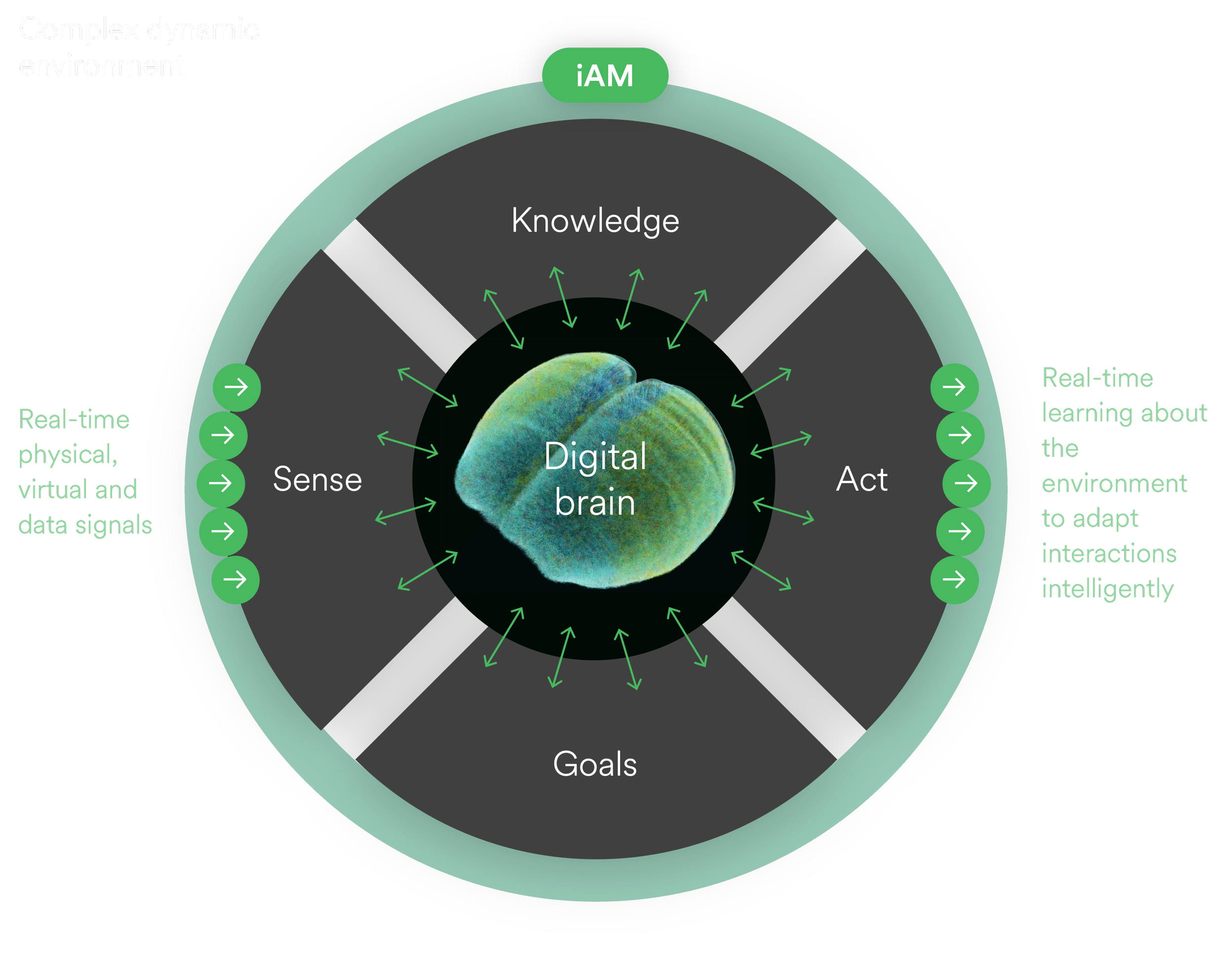
inait Adapative Machines (iAM) Platform: Test, benchmark and QA AI with Digital Brains on customer data; with execution on cloud, device or edge
Digital brains learn to play pong within 10 games to 3 points – hundreds of times faster than state-of-the-art AI
Game 1: first experience of the game
Game 2: learns to hit
Game 4: learns to score
Game 11: learns to win
The same digital brain can learn to play pong in different styles – to win, or collaboratively.
Play to win
Digital Brain with 500 neurons adopt different behaviors
Play collaboratively
Unique Technology Assets
INAIT is building on 20 years of research by 1’100 scientists and engineers on finding the recipe to digitally replicate the brain’s biological design, backed by $300M and led by INAIT’s founder, Henry Markram. INAIT has developed the proprietary operating and learning mechanisms needed to teach digital brains. INAIT has also built technologies for a wide range of industries to connect digital brain technologies with modern AI, perfecting fusion AI.
Our core pillars
Digital Brains as the neural network architecture already evolved for generalizable intelligence
A Neural Code as the foundation of a Digital Brain Operating System to program encoding, processing and decoding computations in digital brains
A Causal Learning Rule as a singular learning rule to teach digital brains to acquire cognitive skills
Fusion AI as a holistic AI ecosystem with digital brains at its center and leveraging modern state-of-the-art AI, such as LLMs, CNNs, and GNNs
Digital Brains
The Open Brain Institute is making the five step recipe for building digital brains available to spark the Age of Digital Brain Building across all species. INAIT has developed the technology to convert these digital brains into neural network architectures that incorporate as much biology as computational power is needed for a particular use case.
iAM Architecture
INAIT has developed the connectors to couple digital brains to modern, state-of-the-art AI–leveraging them for vision, hearing, speech and knowledge to create a wholistic AI that perceives, adapts intelligently to real, virtual and digital environments and can communicate directly with customers to get instructions and explain what it is “seeing, thinking and doing”. We call these systems inait Adaptive Machines (iAMs).
The digital brain delivers advanced cognition and interactive adaptability, while state-of-the-art pattern detection AI provides precise sensory pre-processing. Additionally, large language models add a communication layer, enabling the system to express its actions and decisions in text and even command code as needed.